
Private vs Public Education
Is it fair and equitable or ????

I have been researching this for a while. Mainly because the Private schools receiving public funding don’t have any of their statistics published like Public, Separate, and Francophone school districts in the Alberta Education Information. https://www.alberta.ca/k-12-education-financial-statements#jumplinks-2
Even Charter Schools have to disclose their financial statements to their parent groups. See: https://abresistance.substack.com/p/charter-schools-vs-public-schools
I attempted to locate any information that would reveal the number of students registered at a particular private school or the school’s funding in the public record. It’s not available in any of the searches I did. I did find out, however, that Private schools are eligible for 70% of the money/student that is available to Public, Separate, Francophone, and Charter Schools.
Here is a link to the funding model.
https://www.alberta.ca/k-to-12-education-funding-model
Here is a link to the reporting of education funds to all the schools except PRIVATE/Independent schools (anyone else notice how this government uses words to change the narrative?) https://open.alberta.ca/publications/2828632-2023-2024
A Tale of Two Private Schools: K-12
So I started looking at Private Schools’ webpages and searched for their budget plans. I selected two, one in Calgary - Webber Academy and one in Edmonton - Progressive Academy. Webber is definitely for the well off.
I found Webber’s 3-year plan on their website. Nothing on the government’s website.
Webber’s 3-year budget plan
20% of the funding for Webber Academy comes from the Alberta Government
For the 2025/26 budget, they have 1020 students and a budget of $30,800,000.00 - which works out to $30,196.07/student. (More is likely as they have a Jr. Kindergarten and a regular Kindergarten, so they would be eligible for ECS grants, and they would only have half the payments per student, as they only go half days)
Without the provincial money, they would have an income of $25,800,000. This would work out to $25,294.12/student. More than double what students in the public system get.
The provincial government gives them $5,830,000 for 1020 students (Reminder this is 70% of the funding a public school would get) = $5715.69/student. Their rent is about $5,600,000.00, which means the public system is basically covering their rent. I don’t blame the Private/Independent schools. Would you turn down free money?
The fees are as follows:
Junior Kindergarten - $20,000
Senior Kindergarten - Grade 6 - $22,800
Grade 7 - Grade 9 - $24,000
Grade 10 - Grade 12 - $24,500
Non-Resident Students - Tuition fees plus $5,000
They can enroll students that the public schools can’t because they are non-residents for their school fee plus another $5,000. If you are poor and are of school age in Alberta, unless you meet residency requirements, you can’t go to school.
With their money, they have purchased land to create a sports center. Now, if public dollars are paying for this, then the public should have access to these amenities just like public schools allow access to their fields, ball diamonds, and playgrounds.
Webber Academy Athletic Park •
https://www.webberacademyathleticpark.ca/ (Picture from their website)
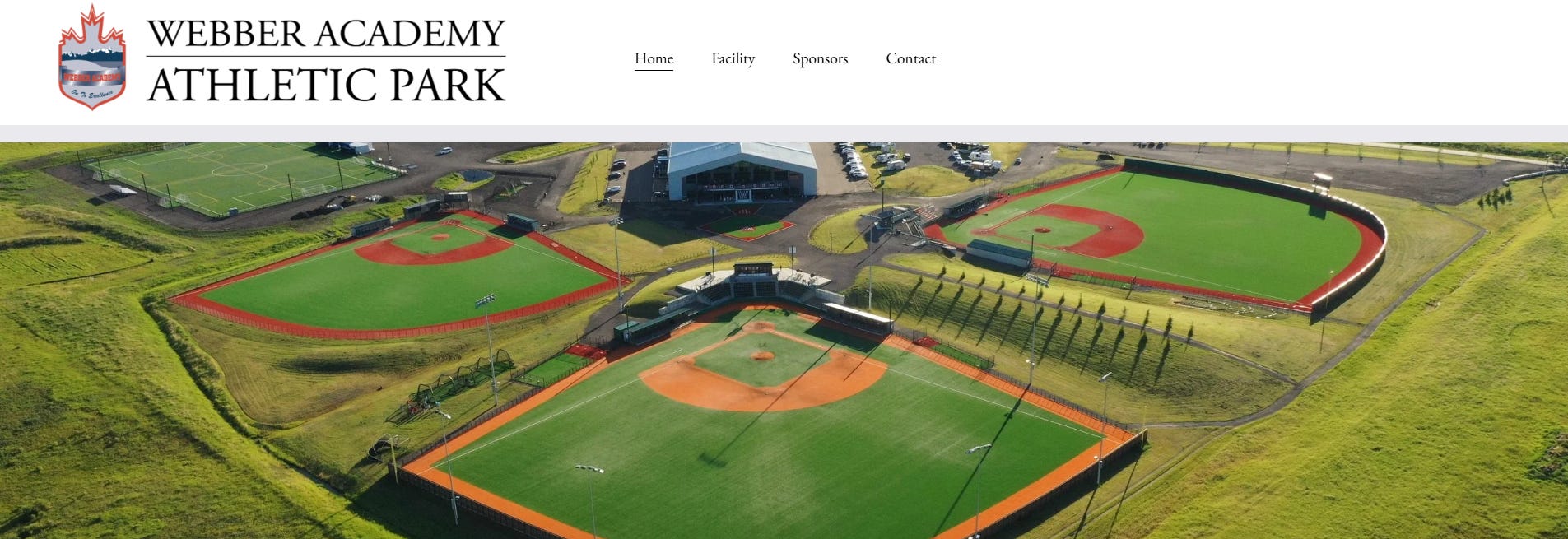
In 2021, the school purchased 530 acres of land located approximately 10 minutes from our current facility. Construction commenced on the grounds for four baseball diamonds, a soccer pitch, and a 50,000 square foot indoor field house. • In the Spring of 2022, the Webber Academy Athletic Park opened a fully turfed baseball field equipped with lights. • In 2023, two additional fully turfed fields were completed, with the fieldhouse in full use. • In 2024, Dr. Webber worked in partnership with the Calgary Rangers Soccer Club to build a turfed soccer pitch at the Athletic Park.
Some of the clubs and events offered: Mathematics Competitions, Mathematical Workshop Invitation, President’s Breakfast, Fundraisers, Field Trips, Grade 5 Heritage Fair, Elementary Science Fair, Birthday Book Program, Senior School Athletics, Wildcats Youth Baseball Camps, Speech Club, Debate, Remembrance Day, Robotics, Forbes 30 Under 30. Model United Nations, Poetry-In-Voice, Voices Magazine, Science Olympics, Designer Gene Club, Women in Engineering, Reach for the Top, Business Case Competition, Debate and Leadership Camp, Banner Brunch, Applied Science Courses, Calgary Invitational Spelling Bee, APEGA Science Olympics, Canada Wide Science Fair, University & Career Symposium, Special Recognition.
How could the public school system use that money?
That $5 million would pay for:
47 Teachers
100 Educational Assistants
2,000 Psychological/Education assessments for diagnosis for at-risk students.
Develop resources for the new inappropriate curriculum. Instead, we fund Private/Independent schools at the highest rate in all of Canada.
2. Now to check out an Edmonton area private school - K-12, The Progressive Academy - Class sizes 17-22. They have 400 students enrolled in their day program.
School Tuition 2025-2026
School Fees for Junior Kindergarten to Grade 12 are based on the September-to-June school year.
Junior Kindergarten - $3,262.50
(This includes the Government of Alberta Affordability Grant.) (* and PUF funding if it is applicable)
Senior Kindergarten to Grade 12 - $11,825
International Student - Please contact us for the International Student Tuition Agreement.
Registration Fee
Registration Fee (per student) - $250
Activity Fee
Senior Kindergarten -$175
Grades 1 to 3 - $355
Grades 4 to 12 - $600
The Activity Fee covers all co-curricular activities throughout the school year. School supplies for Kindergarten to Grade 2 are also included.
Progressive Academy strives to provide the best programs possible, and relies on the support of our fundraising efforts. We are a registered Canadian charitable organization, and therefore our society can issue tax receipts for any donation. Whether you are looking to support the school in general or fund a specific program, you can easily donate through the “Donate Now” button below, or in person at the school.
Please consider helping our school grow! We put every dollar back into making the school even better. (Public schools rely on fundraisers.)
3 year plan: Government funding 44.5% @ $3,437,537, which works out to $8,593.84 per student which added with the $11,825 fee, works out to $20,418.84. https://www.proacad.ca/wp-content/uploads/2025/09/PAES-Education-Plan-25-26.pdf
https://www.proacad.ca/#
https://www.ourkids.net/school/progressive-academy-edmonton/510
Clubs offered at Progressive Academy: Animation, Art Club, Band, Choir, Community Service, Computer Club, Drama Club, Environmental Club, Math Club, Musical theatre/Opera, Outdoor Club, Outdoor Education, Robotics club, School newspaper, Science Club, Student Council, Yearbook
3. Public School - Edmonton A. Blair McPherson - K-9 (For reference Edmonton Public Schools have 214 schools)
https://files.epsb.ca/budgets/1458.pdf (A. Blair McPherson’s Budget)
Let’s compare the private school picture painted compared to a Public Schools.
A Blair McPherson an Edmonton Public School
ABM is a K-9 School in Edmonton. They have 1027.5 regular students and their weighted enrolment is 1168. Their budget is $6,813,547 ($1 million more than Webber Academy and $3 million more than Progressive Academy) which works out to $6,627.96 per student. They have outside organizations that support the school - ATB Financial, Edmonton Immigrant Services Association, Edmonton Public Library (EPL)
https://files.epsb.ca/budgets/1458.pdf
Public Schools are not funded fairly in Alberta. They will blame the administration (EPSB) costs for this, but the truth is the province has underfunded public education using the Average Funding Model based funding on enrolment counts over a three-year rolling average. It was just replaced with the Weighted Moving Average Model which is based on two years - 30% based on last year’s enrollment and 70% projected enrollment for this year - they aren’t funding kids in desks, but rather how many kids they think will show up. In Edmonton they underfunded over 4000 students last year and this year it’s 1000. The high schools will be at 100% capacity next year and this government doesn’t care. They defend funding private and charter students, accuse the public system of being unfair and blaming the other kinds of schools. The truth is the problem is this Alberta Government. They underfund so that they can privatize. Several UCP staffers/families have charter and private schools. They can be for profit, they have rich alumni who often give donations to the schools. Public schools do not. It’s not a level playing field.
This is why Public School Teachers chose to strike. They gave the province months to negotiate. The province chose not to, rather they have used the notwithstanding clause to force Educators back to work.
https://www.cbc.ca/news/canada/edmonton/alberta-change-to-student-funding-formula-aims-to-ease-classroom-pressures-1.7478093
Some more information re: Private schools.
Overview of Accredited Private Schools in Alberta
Alberta’s private schools are categorized under the Education Act as either registered (basic provincial requirements, no funding) or accredited (higher standards, eligible for partial public funding if “funded accredited”). Accredited schools must use certified teachers, align with provincial learning outcomes, and submit annual plans to Alberta Education. Based on the most recent available data (2024-25 school year from provincial reports and directories), there are approximately 140 accredited private schools in Alberta serving K-12 (excluding pure preschool/ECS-only operators). This number includes both funded and non-funded accredited schools, drawn from Alberta Education’s school authority data and cross-verified with directories from the Association of Independent Schools & Colleges in Alberta (AISCA) and School Advice.
These schools primarily serve Kindergarten to Grade 12 (K-12), with grade levels varying by institution (e.g., some are elementary-focused up to Grade 6, others secondary from Grade 7-12, or a full K-12 continuum. Much like Public Schools.) Distribution is heavily concentrated in major cities, especially Calgary (about 60% of total). Smaller communities have fewer options, often faith-based or specialized (e.g., Montessori, special needs).
Below is a breakdown by major city/region, including counts and examples of grade levels. For brevity, I’ve listed representative schools with their grade ranges; full directories are available via Alberta Education’s open data or AISCA. Counts are aggregated from official and verified sources to avoid duplicates.
Total Across Alberta: there are 140 schools
By Grade Level Province-Wide: Elementary-focused: - 44 (31%); Secondary-focused: ~24 (17%); Full K-12 continuum: - 72 (51%).
Notes: Many schools offer Early Childhood Services (ECS/PS/JK) alongside K-12. Specialized schools (e.g., for special needs like Foothills Academy in Calgary, Gr. 3-12) are included if accredited. Enrollment totals - 40,000 students province-wide (5.3% of Alberta’s K-12 population). For the most current list, download Alberta Education’s 2024-25 School Information Report (Excel) from open.alberta.ca, filtering for “Private” authority type.
Funding for Accredited Private Schools in Alberta
Alberta Education provides funding to accredited funded private schools (a subset of accredited private schools that meet stricter eligibility criteria, such as using certified teachers and aligning with provincial programs of study). This funding supports operational costs but is partial, allowing schools to charge tuition to cover the remainder. Registered private schools and non-funded accredited schools receive no provincial funding. Funding is allocated through grants under the Education Grants Regulation, primarily for base instruction, with additional supports for special education or heritage language programs where applicable.
Key Details on Per-Student Funding
Funding Rate: Accredited funded private schools receive 70% of the per-student base instructional grant provided to public schools. This is the highest such rate in Canada and applies to eligible Kindergarten to Grade 12 (K-12) students.
The base instructional grant is the core operational funding component, adjusted annually for inflation, enrollment, and other factors.
Private schools do not receive funding for transportation (Grades 1-12) or certain capital expenditures, though some Early Childhood Services (ECS) programs may qualify. (Students in early education programs receive PUF funding up to 6 years of age, whereas those in public school programs are cut off at 4.8 years.)
No Full Per-Student Amount Specified in Policy: Exact dollar amounts vary by school year, student grade level, and needs (e.g., higher for ECS or special education). They are detailed in the annual Funding Manual for School Authorities (Section 9.3 for private schools). For context:
In 2024-25, total provincial allocation to accredited private schools and ECS operators was approximately $461 million for about 38,000 students (across all private types, but funded schools represent the majority). This equates to roughly $12,131 per student province-wide, but funded schools’ share aligns closer to 70% of public rates.
Public school per-student operational funding (including capital) was around $13,092 in recent years (e.g., 2017-18 data, adjusted upward since). Thus, private funding would be approximately $9,164 per student (70% of that figure), though 2025-26 estimates suggest public rates near $13,421, implying approximately $9,395 for private students.
Notes: Averages include ECS and non-funded elements; actual funded per-student is - 70% of public base. Enrollment grew 15% from 2021-24, outpacing inflation in private allocations. Private schools have access to PUF funding (for young children at risk) through their ECS programs until a child turns 6 years of age, https://childrenslink.ca/wp-content/uploads/2023/03/What-is-PUF.pdf
https://www.alberta.ca/early-childhood-education
Private schools have Junior Kindergarten, whereas Public schools have programs for those who have more severe delays and there are limited programs.
Eligibility and Accountability
Schools must operate for one year without funding before applying, submit annual plans/budgets, and undergo audits/on-site reviews.
Designated special education private schools get enhanced funding for students with disabilities.
Recent Updates (2024-25): Budget increased overall K-12 funding by ~$400 million to $9.9 billion, with private subsidies rising faster than inflation/population growth (unlike public systems). In 2024, private schools became eligible for new construction grants under the Alberta New School Accelerator Program— a policy shift criticized for equity concerns.
For precise 2025-26 rates, refer to the latest Funding Manual on open.alberta.ca . https://open.alberta.ca/publications/1485-5542/resource/c3303ed0-6b12-4774-b6c9-8a6b6115abbf
It is quite a contrast and I don't understand how the UCP gets away with justifying the disparity. Hopefully this shines a light on what is going on. I hope the community can find the funds to fix your field.
Great article and why I joined Albert Funds Public Schools (abfundspublicschools.ca).
That picture of the fields made me so angry. I coached soccer at my local public school. The school in only 6 years old. Our field is a pot-holed mess. We have no baseball diamond, only got a second piece of playground equipment last year (thanks to PTA fund raising). We finally got goal post this year! 6 years for soccer posts! But the field is not usable for teams as it is dangerous to use for competitive sport due to the pot-holes.
Unfortunately, the last school I worked at had similar problems and that was 4 years ago!